Showing posts with label chiang mai. Show all posts

Sunday, September 2, 2012

Vegan Pizza & Bread at Dailycious Cafe

Really?  Vegan pizza?
Yes, really! I've ordered vegan pizza two times now at this cafe called Dailycious. The first time was a bit of an experiment, since "Vegan Pizza" is not actually on their menu. I asked if they could make the "Vegetable Pizza" without the cheese, and they said sure. I've been ordering pizza like this for a number of years now, in various cities and countries. Sometimes my request for "no cheese" gets interpreted as "vegetable pizza with cheese." Or sometimes the cheese is successfully left out, but then there's nothing added to replace it. This often yields a pizza that is either dry, lacking in flavor, or both. Fortunately, I was able to communicate clearly with the waitress here at Dailycious. And not only were they willing to venture off their menu to make a vegan pizza, but they were even kind enough to do half the pizza vegan, and half to my omnivore friend's request for cheese and other toppings.

So did Dailycious live up to its name? Yes it did. My half of the pie was topped with plenty of veggies, a sufficient amount of juicy tomato sauce, and some nice herbs and spices. But what stuck out the most, was the dough. It was fantastic.

So fantastic that I thought it might be flavored with parmesan or some kind of cheese. I actually didn't want to ask and find out, lest it ruin my pizza experience! But when I went to pay the bill, I chatted with the friendly owner a bit, complimented him on how delicious the pizza was, and then just asked. And what did he say the dough is made with? Just four ingredients: flour, water, yeast and salt.  Azzahhh!  Just exactly how I make bread!  And then he told me the reason his dough tastes so great, something he does that other pizzerias in Chiang Mai do not: the dough is made onsite fresh daily, but before being baked, it's kept in the fridge for 24 hours.  This allows the yeast to go to work, some fermentation to happen, and a rich and hearty flavor to develop.  Simple. But brilliant. And not only is their pizza dough made in this fashion, but all their baked goods.
Once the owner told me about that, I decided to buy a loaf of bread (60 baht for vegan whole wheat bread!), and after I left the store, he ran after me to give me free bagels (contain honey)! Man, he knows how to create return customers!
Dailycious truly is a nice cafe. Good food and good ambiance. There's indoor and outdoor seating, very friendly waitstaff, and a whole menu of other food and drink options (including some vegan options, like hummus and pita, which tasted great as well).

Once I got home, I tried out the Dailycious bread, and it tasted as great as the pizza dough. I enjoyed it over the next few days in various ways, such as toasted and topped with these fine ingredients I got at an Organic Market (that I'll talk about in my next post!).
Avocado, cabbage, basil and parsley.
I made two open-face sandwiches with these ingredients.
Crispy toast, crisp cabbage, tender avocado, blasts of herbs, and some nutty ground flax seeds sprinkled on top. Looooved this open-face sandwich.
The next day I toned it down a bit, and just toasted the bread to have on the side of a suki-style veggie soup I made.
Warm soup, warm bread, and a cool fruit. Temperature cool yes, but cool-looking too! Yes, that's right. That scarlet-colored fruit you see in the background is indeed dragon fruit.
Mmmm, yes, one of Thailand's great tropical fruits. Beautiful and delicious. Which is to be expected here! But what you may not expect to find so easily in this country is great-tasting vegan pizza. But if you're craving it, here's how to find it:

Driving south from the southwest corner of the old city towards Central Airport Plaza Mall (Robinson), along Hang Dong Road, you'll see a sign for "NIM City Daily Plaza" on your left just before you get to the mall intersection. Go into this shopping plaza, and Dailycious will be the first shop on the right. There are some other restaurants and shops in this plaza, as well as Rinping Supermarket.

Dailycious Cafe
197 Nim City Daily Project, Mahidol Road
Tambon Hai-Ya
Chiang Mai, Thailand 50100

Phone: 083-321-3621

Sunday, August 5, 2012

King's Royal Project: Organic Market

Lately I've been thinking about the concept of organic food.  "Organic" is a word that's thrown around quite a bit.  And honestly, since being back in Thailand, I haven't paid much attention to it.  I don't really run across an abundance of organic markets, restaurants, or even grocery story items in my every day life.  So even though I had been buying mostly organic food the last time I was in the US, it has basically drifted off my radar these last 7 months or so.  Until recently...
A friend who's lived in Chiang Mai for awhile gave me a little talk about the essential difference between organic and non-organic produce: chemicals.  Most likely, unless you're growing your own fruits and vegetables here in Chiang Mai, the produce you'll find at markets and grocery stores has been sprayed with toxic chemicals, to kill the bugs and weeds.  Maybe we don't normally call pesticides and herbicides "toxic."  But then again, if they didn't have the ability to kill bugs and weeds, how could they be anything except toxic?  The immediate effects of these chemicals on the human body are probably minimal, but over time, they accumulate, causing sickness and disease.  I can't do a whole lot to control my environment; the pollution in the air is not going away any time soon.  But I can make an effort to control what I put in my body.  But how?  Well, this blog post about organic and non-organic food by my friend Lee gave me some great information, and some good encouragement, too.

I also got some practical advice from two professors at the college where I teach, who led me to this ORGANIC market right in Chiang Mai:
It's located just to the east of Chiang Mai University.  From what I understand, this bi-weekly market is a part of CMU's department of agriculture, as well as being under the patronage of the King's Royal Project.  Some of the produce comes from crops on CMU's campus (see the first two pics in this post), and other is brought by farmers in the surrounding area.  All farmers' fields are checked on regularly to ensure that chemical herbicides and pesticides are not being used.
There are probably about a dozen or more different vendors, selling all sorts of vegetables, herbs, fruits, and even rice.  The market is open twice a week, Wednesdays and Saturdays from 5am until about 2pm.  It's best to get there early, but honestly, I haven't ever gotten there before 10:30 am, and there's usually still a fair amount of veggies left to choose from.
When you see carrots shaped like this, you've gotta know they're organic!  A little bumpy, but comforting.  When I cook up and eat these funny-looking roots, I know that I'm getting all their vitamins and nutrients, sans toxic elements.  So I purchased some of these carrots, along with a bunch of other good stuff!
Multi-colored (multi-grain) rice, cauliflower, mustard greens, carrots, bamboo shoots, limes, cucumbers, limes, mushrooms, pumpkin, kale, and rolls of dried mango. I dished out about 200 Baht for all this, and felt like that was a lot to spend on groceries.  But once I laid it all out on my table and remembered that 200 Baht is only $7, I felt pretty rich!  Eating organic in Chiang Mai doesn't have to be expensive - yay!  Honestly, I think if any of these items were more expensive that what I'd pay at a regular non-organic market, it was by pennies if anything.

I had a great time cooking a few different dinners with this purchase.  Unfortunately, by camera's SD card died from a virus and I lost the pictures.  (Quite the bummer, and which is partly why I haven't posted in this blog for awhile!)  But here's a picture of a meal I cooked with produce from my second Saturday shopping spree at the same CMU-King's Royal Project Organic Market: Stir-fried Eggplant-Mustard Greens-Mushroom over rice.

I used onion, garlic and chilis for some spice and zest; plus the three flavors of salty (soy sauce), sour (tamarind paste) and sweet (raw sugar). First, I sauteed the onion, garlic and chili for a minute.  Then I removed them fromt eh pan to start cooking the mustard green stems.  I don't know if people generally eat the stems or not.  But it seemed like a lot to cut off and throw away, so I wanted to give it a try.  I kind of steamed/-stir-fried them for a few minutes (oil in the pan, add some water so it boils and steams) until they started getting soft. Then I added the mushrooms, then the mustard green leaves, along with the soy sauce, tamarind paste and sugar.  It just took a few minutes to cook.  Placed atop some rice, and voila, done!
I love the chewiness of the mustard greens, which is different from the mushrooms' chewiness, and then the more crisp and solid eggplant.  And I'm pretty happy with the way my "four-flavor sauces" are turning out lately.  It definitely feels like a good balanced meal, especially when I have some nice tropical fruit for dessert: lychees!
So, I'm super happy to have found this organic market.  I'm planning to check out some organic markets in the next few weeks that I've found out about.  And I'm going to make an effort to eat at some organic restaurants too - which should be fun to blog about!  So I'll keep you posted!  For those of you who are in Chiang Mai, I hope the info is helpful; and those of you who aren't here, I hope you can soak up a little of the joy I've found by knowing that it's not so hard (or too expensive) to find good organic food here, and probably almost anywhere in the world you may be!
Here's the sign in front of the market, whose literal translation brings some new light to what "organic" means: 
Poison-Free Agriculture Market
Danger-Free Food
Every Wednesday and Saturday
6am - 2pm
Location: Agricultural Research Zone


Thursday, May 24, 2012

Home Cookin'!

I actually did some cooking at home recently. In my NEW home, that is. Just moved into a new apartment on the campus where I'll be working as an English professor starting in June. Since the campus is a little outside the city of Chiang Mai, there isn't as much easy access to restaurants and street food. I will definitely miss the back gate of Chiang Mai University, with the nightly street vendors and plethora of restaurants, but I am happy to have the chance to cook at home again. On my first night in the new place, my flatmate took me to the nearby market to buy some vegetables and rice.
She also let me use all her utensils and cooking stuff, which is great because I don't have much! But what much do you need? A pan, some oil and soy sauce, fresh veggies, rice....  I actually bought the rice at this little shop down a dark alley behind the market that had huge barrels of rice for sale by the "leet." I got one leet (I think it's a take on the word "liter") of brown rice for about $1. Don't worry, it wasn't as scary as most dark alleys would make you assume, but the convenience store only sold big bags of white rice so I really didn't have a choice! Not having a rice cooker, we used this pot, with water in the bottom and a lid on top, to steam the rice.
While the rice was cooking, I prepared the veggies. I don't know the English name of this green vegetable.
And in Thai, I only know the name of its relative: phak sayotay. This particular one I'd never tried before, but my roommate said it's similar, just a little more bitter.  Hmm... bitter, who likes bitter? I decided to give it a try. I'm pretty sure it comes from the greens of a pumpkin plant; the little curly-q's are the giveaway. Chopped straw mushrooms and Chinese cabbage were the other two main ingredients. First, I sauteed some garlic in oil, then added the mushrooms, then the cabbage and greens.
I added some water to help steam and soften the vegetables. That also helped to make a bit of a sauce. Then I added some soy sauce. And to balance the bitter a little bit, I added a teaspoon or so of raw sugar. Here's my roomie, Ajaan Aoy, giving me a hand.
The brown rice was taking over an hour to cook, so I eventually abandoned that plan and just ate the veggies with some leftover white rice, because it was getting so late.
I like the vegetables to be just a little crisp; definitely not mushy. It's a pretty simple meal: rice and veggies. A nice inaugural cooking experience in my new home. Were the greens bitter? Yes. But I loved it! Ajaan Aoy told me that, biologically speaking, eating something bitter enhances your appetite. This could very well be true... or else I was very hungry! Either way, each bit I took of the bitter greens tasted better than the previous. Having the sweet sugar and the salty soy sauce made for a really nice flavor medley. I could try making this again with the added component of spicy. Maybe saute some chilis with the garlic... mmm...
I was quite satisfied with the dish as it was. And the next day, I definitely ate the leftovers with the brown rice that eventually cooked!


Tuesday, February 21, 2012

Eating Out


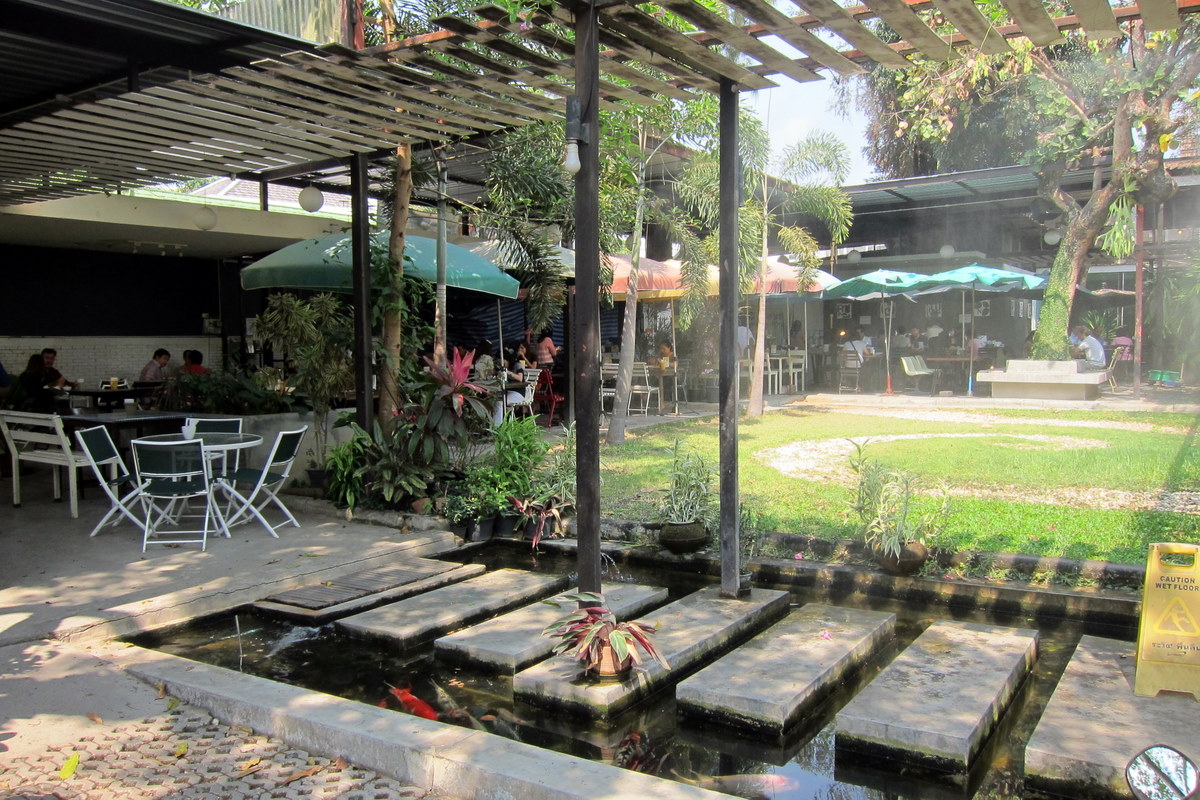
This little gem of an outdoor seating area is found at Khun Churn's Vegetarian Restaurant. No matter how hot it may be in Chiang Mai (it's still February, so not too bad yet), you can count on a cool misty breeze, a peaceful and shady ambiance, and cruelty-free food.  And especially at lunch time, you can get it for a great price!  The lunch buffet is 129 Baht (about US$4) per person, and this includes a huge salad bar, brown rice, a bunch of main dishes and soups, side dishes like som tam and various things to dip in various sauces, dessert, and even a selection of different herbal teas and fruit juices you've probably never heard of.
I've been to Khun Churn's a number of times, and this time I went with Ajaan Mike & Ann, who were the first people to take me here! We all started off with the salad bar.
Yes, those salad greens sure did tower. And they were surrounded not only by lots of salad items you might expect (red cabbage, carrot, green peas, tomatoes, cucumbers, broccoli, bell peppers, shredded beet, shredded yellow squash, tofu slices crispy on the outside), but also some you might not expect if you've never eaten at a Thai salad bar: kidney beans, barley, taro chunks, pineapple, guava, papaya, apple, steamed sweet potato....
So as you can see, you can create yourself quite the rainbow of a salad! There were about five or six different kinds of homemade dressings to choose from as well (soy sauce based, peanut-based, caesar style, sesame based, etc.). I chose the peanut-based one and dolloped a few spoonfuls all over my salad. I have to say, my idea of what can be part of a "salad" has expanded a lot. I like putting nuts and legumes in my salads for some extra protein. I like lots of greens, and a bunch of fruit too. Tomato is a fruit anyway, so why not add some some apple and papaya pieces? I used to think it was crazy to have "salad" as a meal, but when I fill my plate with a variety of grains, fruits and vegetables, I feel full and happy.
I chose lemongrass tea to have with my first plate of food. Lemongrass is a common ingredient in Thai dishes like Tom Yam, but it can also be a tea.  It aids in digestion and promotes clear skin apparently! All the teas at Khun Churn's are unsweetened, and then you can add as little or as much syrup as you like.
Since I had eaten a big breakfast, I wasn't too hungry after my big plate of salad, so I bypassed the soups and main dishes...
... and got a plate of some favorite tidbits:
On the left is vegetarian som tam (papaya salad, which I featured in my last post) with coconut milk rice. I was curious what Khun Churn's version of "vegetarian som tam" would taste like. I thought it tasted pretty good. It was definitely on the sweet side, just a little spicy, with less of an emphasis on salty and sour. That paired with the sweet coconut milk rice was a new take on som tam, but I have to say that I kinda liked it!
On the bottom and right of my plate are some different deep fried food: spinach, tofu and some kind of gourd squash. Each one had its own specific dipping sauce to go with it (spicy, peanut-based and sweet). You can't go wrong with deep fried battered anything! On the left is another chunk of steamed sweet potato from the salad bar (it was sooooo sweet and tasty!). And the bowl at the top is a traditional Northern Thai dish called Khao Soi.
Khao Soi is a spicy red curry soup, usually with some coconut milk in it. It's usually cooked with chicken and served in a bowl over egg noodles. So, I left out the egg noodles, and the chicken is replaced with some texturized soy protein. So, I didn't really think about it, but the crispy noodles that I put on top (which is typical), are also egg noodles. Oops, so I guess I ate the egg noodles after all! This dish is one of my favorite Thai dishes. It's got a realllly tasty curry that is spicy and sweet and creamy at the same time, not overly salty, and fresh lime squeezed on top gives it some sourness as well. YUM! Also, I think it could be served over brown rice instead of egg noodles and taste great. Or just eaten plain like a soup!
I chomped down this plateful of food while sipping on Bael Juice (a kind of fruit called น้ำมะตูม in Thai - Ma-tum - that takes 11 months to ripen on the tree). I looked it up on Wikipedia, and there was a section titled "Hazards," which read: "during the bael season there is danger from falling fruits which are very hard and heavy. They can cause injury and property damage."  Ha!
Well, no damage will be done to your head, your stomach, or your soul when you eat at Khun Churn's! Great quality authentic Thai food at a great price, all vegetarian and mostly vegan. Check it out!
Khun Churn's has a regular menu from 8am-10pm, apart from the 129 Baht buffet from 11am-2:30pm. You can find it at Soi 17 of Neimanheiman Road in Chiang Mai.

Wednesday, February 8, 2012

Back in Thailand!

Hey friends! I didn't blog at all during my last two months in the US, and now I've been in Thailand for a month. So I suppose I'm a bit behind. But there's no race going on here, so I'll just jump back in with a picture of my favorite Thai dish: SomTam!

SomTam (ส้มตํา) is called Papaya Salad in English. If you've ever eaten fresh papaya, you know that it is a vibrant orangish-pink color, but you don't see any of that here! This is because SomTam is made with green papaya, or papaya that has not yet ripened. The flesh, still a light green color, is grated into narrow strips that look a bit like noodles. It's made in a big wooden mortar and pestal, where all the ingredients are pounded and mixed together. This includes garlic, tomatoes, green beans, and peanuts, plus the four elements of salty, sweet, spicy, and sour. Thai chilies provide the spicy, lime juice the sour, a sugar cane paste the sweet, and fish sauce is usually the salty.

So last year in Thailand, fish sauce was the one animal product that I only gave a half-hearted effort not to eat. It's usually considered such an integral part of Thai cooking that it cannot be replaced without altering the dish's true taste. Sadly, I was also a bit too shy half the time to even try to order without it! Well, there's a student in the program I'm working with this year who is allergic to all seafood, including fish sauce. So it basically became my job to find delicious Thai food with no fish sauce - 100% vegan!

This very dish of SomTam you see here was my first try at ordering it without fish sauce. I said ไม่ไส่นํ้าปลาค่ะ ("mai sai naam bplaa" = please don't add fish sauce), and amazingly enough, the woman making it thought nothing of it! She just used salt instead, calling it SomTam Jay. Jay - เจ - more or less means vegetarian. So how did it taste? Fantastic! And only 20 Baht (about 66 cents)!

Here are two other random vegan eats in Thailand. Passion Fruit Juice...

... and Stir-Fried Noodles with Tofu & Veggies (ผัดซีอิ๊ว = Pad Siew):

Saturday, June 18, 2011

An Impulse Buy


When it comes to shopping, I probably only have a few weak spots.  Perfect notebooks.  Pants long enough for my long legs.  And new fruit.  If I see a fruit that I've never eaten before, much less even come across in real life or pictures, I pretty much have to buy it on the spot.

So when I went to Chiang Mai's Walking Street last month, it was mainly for the purpose of spending time with my friends who would be heading back to the U.S. the following week.  I knew I didn't need any more scarves or paintings or gifts for family. I did end up buying a great pair of earrings after about 15 minutes of contemplating and choosing.  But what I did buy on the spot without hesitation was a half kilo of lychees.


I'd heard of this fruit for years, but  never stayed in Thailand past May to when they are in season.  For less than $2 (I think I paid 50 Baht), I took home a half-kilo.  I brought them out to the balcony to eat, because I had a feeling they'd be a little juicy and messy.  They're quite pretty to look at, I just had to figure out how to get them open.


I used my thumbnail as tool of choice.  Worked quite well, as the outer skin is dry and dense but thin, so I could pierce through it fairly easily.  As I guessed, it was nice and juicy!  But meaty, not mushy.  It was probably perfectly ripe, given that they are grown in Thailand (as well as China and Vietnam).  At this point in the "lychee experience," it was really reminding me of a rambutan.  Thinner shell, but similar texture, and a very similar-looking rubbery translucent white inside.


I know a lot of people really like rambutan.  I admit, the spikey red "hair" on the outside is quite attractive, but i don't think the flavor is that amazing.  And beyond that, I'm really turned off by the way the meat sticks to the inner seed/pit, so that when you try to maximize what you can chew off, you inevitably get some of the dry cardboard-like seed coating.  Lychee, on the other hand, does NOT have this problem!  The seed doesn't cling to the meat at all.


The seed has its own smooth outer coating, so it doesn't stick to the a bit.  And the taste?  Really flavorful, juicy, chewy but soft, not sour, not tangy.  Just sweet yummy satisfaction.

I do find it interesting that lychee is called ลิ้นจี่ in Thai, which is procounced "lin^chee\."  In Korean it's called 그 열매 , which is pronounced "gue yeolmae."  However, rambutan is called เงาะ in Thai, which is "ngaw/," but it's called 램부탄, "raembutan," in Korean.  Seems that we borrow, share, copy and differentiate as we please in the world of languages.  I will close with one word I hope we all can share: peace.